

Between Creeks and Hills: Indigenous Life in What We Call Rockridge
by Liam Pierce
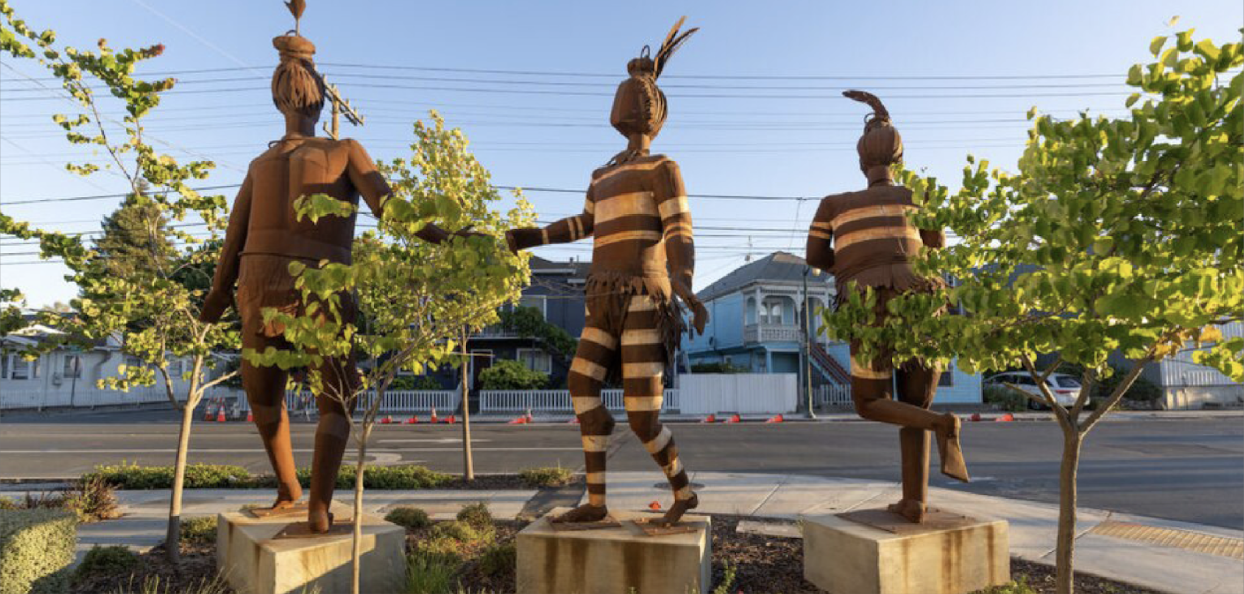
When Coyo Tena was 14, he was hesitant to join Sogorea Te’ Land Trust’s youth program, worried about putting too much on his plate his freshman year at Oakland Tech. But he eventually gave in to his mother’s insistence, and his skepticism melted almost immediately.
With Sogorea Te’, Tena developed a love of nature. He learned how to weave pouches out of salmon leather, identify plants and craft medicines, survived a tsunami warning on a kayak trip (long story) — and made many friends. Four years later, Tena, now 18 and a senior, earned an internship with Sogorea Te’ this past summer.
“The main point of the youth program is to be in touch with the land — especially as Black and brown kids,” said Tena, who is part Tejano and part Yaqui, from what is now Texas and Northern Mexico. “And to learn from what Ohlone peoples have been doing and how you can apply that to your daily modern life.”
Sogorea Te’ is an Ohlone- and women-led organization focused on returning Indigenous land and artifacts to Ohlone stewardship and revitalizing cultural practices in the East Bay. Rockridge lies within that territory — known as Huichin, ancestral land of the Chochenyo-speaking Lisjan, Muwekma and other unaffiliated Indigenous peoples. It is important to recognize whose land it was and whose land it still is.
Today, within the land that the Rockridge border fell on, there are few visible clues of the deep history beneath the neighborhood’s sidewalks, shops and tree-lined streets. This absence itself tells a story of intentional erasure since European contact, lack of artifacts or lack of searching. But there is a story to be told in the absence of Indigenous findings in Rockridge — and the information that surrounds its borders.
Imagine Rockridge not as an assemblage of property lines, but as a dynamic, living ecosystem. Following seasonal logic, families moved inland from the warmer, abundant bayshore shellmounds in the winter to tule and brush homes in the oak-rich foothills during warmer months. This was a site of sustained residency and specialized cultural practice.
The rhythm of life was symbiotic, driven by the specialized labor of the community. The Ohlone diet was anchored in the acorn, harvested from oak woodlands and typically processed by skilled women. They would pound and leach the meal with water to remove bitter tannins, transforming it into nourishing porridge, soup, bread or cakes. The woods, marshes, and creek meadows of the Rockridge territory were an open pantry of seeds, berries and bulbs.
“Imagine the redwood trees here being as tall as the ones up north,” said Francis Mendoza of the East Bay Regional Park District, referring to vast, fog-fed forests east of Rockridge. “Ohlone would use the redwood leaves as a natural water break in creeks to filter the bitter tannins out of acorn meal, adding a subtle flavor.”
Mendoza noted that like the oak woodlands that were Rockridge, the towering redwoods were considered to be elders, reflecting the belief that animals and plants were part of their family, their relatives.
Men, through patient observation and expert knowledge, hunted deer and elk with sculpted bows in the higher hills, utilizing sophisticated decoys and mimicking animal gait — a practice that required deep understanding of animal behavior.
Children contributed to both men’s and women’s roles, learning every hill and plant by name, inheriting an understanding of the world where the spiritual was interwoven with the physical.
While labor was often divided along lines of gender, the Ohlone didn’t ascribe to rigid gender binaries. They acknowledged and accepted individuals with “Two-Spirit” identities. Two-Spirit individuals often held special valued spiritual, social and labor roles within the tribe, effectively bridging traditional divisions of work.
But how do we know that this is what life was like within the Rockridge border? Well, we don’t for sure.
In the Oakland History Room, a 1910 Rockridge Gazette celebrates “the first house built there” 150 years ago, ignoring the thousands of years of tule and redwood dwellings that likely stood on this soil. The Rockridge BART foundation was unearthed in the late 1960s with no legal requirements for archaeological surveys.
Local property owner John Allen hasn’t found any artifacts on his properties, but is currently working with two tribes using subsurface radar to detect if there are any artifacts below his property at 5299 College Ave.
“How would you feel if somebody dug into your grandmother’s grave?” Allen said, adding he was happy to comply.
But the absence of recorded history (so far) doesn’t mean nothing was here; Rockridge is surrounded by evidence.
Three widely known sites frame the neighborhood — and reveal why Rockridge’s land was significant. To the west stood one of the great shellmounds, which was largely destroyed to make Bay Street Emeryville shopping center.
To the northwest, another shellmound near the I-80 University Ave. exit was successfully returned to Sogorea Te’ stewardship in May 2024.
These shellmounds suggest that Ohlone communities followed creeks from there, eastward for springtime migration. One path likely followed Temescal Creek, which still flows mostly underground beneath Highway 24 and the BART station. And where there was water, there were Ohlone.
The third known site sits at the boundary between Rockridge and Temescal, east of 51st and Telegraph. The word “Temescal” is a Spanish distortion of the Nahuatl word for sweat house, a central place of ceremony, suggesting a permanent village nearby.
While describing Ohlone life is susceptible to overly romantic imaginings, we should acknowledge the violent interruption to that life that came in waves. Spanish missions forced relocations and sterilized Ohlone. Mexican secularization dissolved land holdings. Under U.S. rule, the Gold Rush brought state-sanctioned genocide at $5 per severed Ohlone head. Shellmounds became construction fill. Sacred objects were taken by private collections and museums.
Then development: roads, homes, rail lines, tunnels. If history is what we choose to preserve, erasure is what we choose not to see.
For Tena, the program was a reminder that Indigenous peoples in the Bay Area aren’t just sepia-toned museum displays. They are here today — still connected to the land, still shaping it and still reclaiming their place in it.
“Learning Native history in school was great, but it was always in the past tense,” Tena said. “I was like, ‘what the heck? I’m still here.’”
And despite generations of efforts to bury that past since European contact, Ohlone descendants remain. Sogorea Te’, led by Tribal Chairwoman Corrina Gould, and their goal to rematriate the land is a testament to that.
Even if we never uncover a perfectly preserved village beneath Rockridge, we know this land was and is lived on, cared for and shaped by Ohlone people. That history isn’t gone; it’s being reclaimed. Everyone in Rockridge has the opportunity to support that work, to honor the original and current stewards of the land, and to help bring its full history into view.
INDIGENOUS-FOCUSED GROUPS THAT HELPED WITH THIS ARTICLE
Kanyon Konsulting kanyonkonsulting.com
East Bay Regional Park District regionalparksfoundation.org/donate
Indian Canyon patreon.com/IndianCanyon
Sogorea Te' Land Trust sogoreate-landtrust.org/shuumi-land-tax
Muwekma Ohlone Preservation Foundationmuwekmafoundation.org/donate
